
Observatory essay · 4 August 2026
The Case for Assurance Infrastructure
The technical argument that checking AI-generated evidence, not producing it, is the binding constraint on government analysis; the research avenues that would relax it; and sixteen tractable projects, ranked by probability of delivery.
Plain-English version: Who Checks the Machines?The same argument without the technical machinery · about a 15-minute read · select to expand
Governments are about to be able to read everything. Whether they can trust what they read is a different problem, with different economics. It is the problem that binds.
In 2025 a British government tool called Consult read more than 50,000 responses to a public consultation and sorted them into themes. The machine time cost £240, about the price of an office chair. Two practised panels of human experts then checked its work. Their 22 hours cost, at ordinary loaded rates of £50 to £80 an hour, between £1,100 and £1,760 — five to seven times the machine bill. In the first government AI deployment measured end to end, checking the answers accounted for 82 to 88 per cent of the direct cost of the exercise.
That ratio, and what it would take to change it, is the subject of this essay.
The trend everyone quotes runs the other way. At fixed capability, the price of a unit of AI agent work (a model reading, reasoning and writing on its own for an extended stretch) has been falling at a median of roughly fifty-fold per year on Epoch AI's published series. The length of task that leading models can finish has been doubling every three to four months on the fits published by the evaluation group METR. Put the two together and a question follows naturally: what could a department do with a million agent sessions? Read every consultation response, every local plan, every hospital account, every published study bearing on a question, one machine pass per document, overnight?
It could, and soon. But the question skips the part that binds. Generating candidate analysis is the cheap half of evidence. The expensive half is establishing that what was generated is true, properly sourced and reproducible, and that half is not getting fifty times cheaper each year on its own. As generation cheapens, the checking share of every analytical pound rises mechanically. The reading-everything future is real and it is buyable, but only by whoever builds the verification machinery first.
A session is not a unit of insight
Public discussion of government AI tends to assume a simple production function: more agent sessions in, more policy insight out. Four pieces of arithmetic, each with recent empirical backing, say the function does not exist. What a session contributes depends on the machinery around it, and mostly on the machinery that does the checking.
Copies are not opinions. When many agents answer the same question and their errors are even slightly correlated (shared training data, shared architectures, shared blind spots), averaging their answers saturates fast. Survey statisticians have known the algebra for decades: at a pairwise error correlation of just 1 per cent, a million calls carry the evidential weight of about one hundred independent opinions, however many more you buy. At 10 per cent, ten. And the evidence points to the pessimistic end. One study found that thirty agents debating a hard benchmark produced no more diversity of answers than a single agent working alone. Another, comparing hundreds of models, found their mistakes becoming more alike as they improve, so a second opinion from a rival company's model increasingly means paying twice for the same opinion. A third, in Nature Machine Intelligence, found no sign that mixing model families escapes the ceiling.
The escape is architectural, and it matters more than the ceiling itself. The saturation applies to redundant answers to the same question. If a million episodes each tackle a different sub-question (a different document, a different data pull), the algebra never bites, because the episodes are no longer estimates of one common quantity. Architecture decides whether a deployment is a very expensive poll of one newspaper or a census of a library.
Queues do not parallelise. If 5 per cent of a job must be done in strict sequence, no army of agents delivers more than a twentyfold speed-up; if 30 per cent, barely threefold. Amdahl's law, from 1960s computing, and it applies with full force to agent teams. When Anthropic set sixteen parallel agents to build a C compiler, progress stalled the moment they reached the Linux kernel: every agent hit the same bug, fixed it, and overwrote the others' fixes. Sixteen agents were no better than one, because all sixteen were queuing at the same serial obstacle. Progress resumed only when the human operator restructured the task into genuinely parallel pieces. Questions of the form "what does this one causal chain imply" have long queues and low ceilings. Questions of the form "what do all 50,000 responses say" have almost none.
You cannot extract from sources more than they contain. No amount of processing adds information about the world that the inspected documents lack; a million readings of the same 200 papers buy little beyond a few dozen well-diversified ones. Mass agent work earns its keep only when the corpus is vast relative to human reading bandwidth. Call it the evidence census: one pass, or a small tree of passes, per source object, over tens of thousands to millions of objects. The Consult deployment is the prototype at 50,000 objects. Outside the census class, useful scale tops out at numbers closer to the tens of agents the research literature actually studies.
Long chains rot. A task of one hundred steps, each 99 per cent reliable given the steps before it, succeeds 37 per cent of the time end to end. Raise per-step reliability to 99.9 per cent and the chain succeeds 90 per cent of the time. Everything that buys that extra nine is a verification mechanism: tests, retries, checkpoints, a known-good reference to compare against. The compiler project's author reported that the task verifier had to be nearly perfect or the agents would diligently solve the wrong problem, and that most of the human effort went into tests and build infrastructure rather than into the agents. Long-horizon autonomy is a verification problem wearing a capability costume.
Notice what all four bounds have in common. None says agents are weak. Each says that the value of agent work is set by the machinery around it, and that the load-bearing part of the machinery is the part that checks.
The one deployment measured end to end
Consult supplies the only full accounting so far, and it is worth reading closely. Twenty-two expert hours spread over 50,000 responses is 1.58 seconds per response: necessarily a sampled audit of aggregates, never an item-by-item review. Nor did the machine scrape through on a technicality. Its categorisations agreed with one or both expert panels almost 83 per cent of the time, while the two panels agreed with each other only 55 per cent of the time — an easier test than pairwise agreement, so it shows the tool is usable rather than superior, but usable it was.
Sampling theory explains why the audit could be so small, and where that stops working. For large collections of similar outputs, the statisticians' "rule of three" says that certifying an error rate below 1 per cent, with 95 per cent confidence, needs about 300 randomly sampled clean checks, whatever the size of the collection. Three hundred checks certify a corpus of 50,000 items or five million equally well. The cost of assurance scales with the error bound you demand, not with the volume of machine output.
Three conditions attach, and each becomes a research problem later in this essay. The sample must be genuinely random. The checker must actually catch the defects they inspect (real reviewers miss things, and nobody has yet measured the miss rate for this kind of work). And errors must not hide in corners a random sample rarely reaches, which is exactly where an adversary will put them. An average error rate is not always the right target either: one fabricated quotation can matter more than a thousand harmless misclassifications. But the basic arithmetic is friendlier than intuition suggests, and it is the reason the reading-everything future is auditable at all.
What machines can check, and what they cannot
Not all claims are equally checkable, and the differences are where the money is. Picture the contents of an analytical report as a stack of four layers. At the bottom sit extractable facts and citations: a quotation either appears in the frozen source document or it does not, and a machine can check every single one at near-zero marginal cost, provided the source has been "frozen" — fingerprinted cryptographically so that it cannot quietly change after the fact. Above that sit statistical claims, which can be re-computed: given the data and the code, a machine re-runs the calculation and confirms the published number, and even without the data it can check a document's internal arithmetic. (The statcheck programme found that roughly half of published psychology papers contain at least one internal reporting inconsistency, using nothing but the papers' own text.) Above that sit causal claims, where the formal logic can sometimes be certified but the substantive assumptions cannot. And at the top sit framing and value judgements, which no machine can convert into a checkable claim, and should not pretend to.
The strategic move for any institution is to push its analytical products down this stack, with claims tagged by their type and their check, sources frozen and computations replayable, so that machines verify the bottom layers exhaustively and scarce human judgement concentrates at the top, where only humans can supply it.
One measured detail shows how much this matters in practice. Recent audits of AI "deep research" tools find that their citation links resolve 94 to 100 per cent of the time, while the cited sources actually support the claims made only 39 to 77 per cent of the time. The check everyone builds first (does the link work?) is the one with almost no discriminating power. The gap between "the source exists" and "the source says that" is where the checking effort belongs.
The flood arrives whether or not the forecasts do
Everything so far assumes government chooses to use agents. The strongest reason to build checking machinery does not.
In 2017, the US Federal Communications Commission received more than 22 million public comments on its net-neutrality rule. The New York Attorney General later established that nearly 18 million of them were fabricated. A single 19-year-old, using automated software, submitted 9.3 million fake supporting comments; an industry campaign paid roughly $4.2 million for 8.5 million more — about 49 cents each, for text of template quality, years before modern language models existed. Text generation is now three to four orders of magnitude cheaper and individually styled. Whatever a department decides about running agents itself, the channels through which it receives evidence (consultations, calls for evidence, correspondence) face this at scale. That some synthetic evidence is already arriving in the UK is hard to doubt; the forecastable event is its detection and public documentation, which the technical version of this argument assesses at a calibrated 0.65 by the end of 2029.
The tempting response is detection software, and it is a losing game that loses in the worst available way. Detectors are theoretically bounded by the shrinking statistical distance between human and machine text, and their false positives fall disproportionately on non-native English writers and unusual styles. Under UK public law, consultation responses must be conscientiously considered; a screening regime that quietly discards genuine submissions because a classifier misfired, with errors that track protected characteristics, is an invitation to judicial review, not a safeguard.
The workable alternative builds provenance in rather than screening fakery out. Commit first, audit second: before any sample is drawn, the operator publishes a cryptographic fingerprint of the entire corpus and all outputs, and the sample indices come from a public randomness source nobody can steer. An audit of a collection the operator can quietly repair, once they learn which items will be inspected, certifies nothing. Offer a verified-identity tier alongside an open one, so authentication adds signal without excluding anyone. Require campaign organisers to disclose coordinated submissions, as the Elections Act 2022 already requires for digital political material. And beneath all of it, aggregate by argument rather than by volume: cluster submissions making the same case and cap any one cluster's weight, so that ten thousand copies of a talking point count as one argument, not ten thousand voices. (A cap is itself a judgement, since sheer mobilisation can be evidence of who cares and who is affected, so it must be declared rather than buried in the pipeline.) A consultation analysis built this way can publish, alongside its conclusions, the fraction of fabricated submissions it would take to flip each headline finding. Contamination-resistance becomes a stated property instead of an assumption.
This is the sense in which the recommendation is forecast-proof. If agent capability keeps compounding, government needs this machinery to use agents at scale. If capability stalls, it needs much of the same machinery to defend its evidence channels against everyone else's agents. The shared core appears in both columns: provenance receipts, frozen corpora, sampled audit.
Building the checking machinery
Little of what is needed is new science. It is mature machinery from older assurance industries that has never been pointed at AI-generated evidence. Election administration spent two decades building risk-limiting audits: sequential checks that certify an outcome with a guaranteed cap on the probability of wrongly certifying, examining as few items as the evidence permits and escalating automatically when it resists. Prediction-powered inference, published in Science in 2023, combines machine labels on a whole corpus with human labels on a small random subsample to yield confidence intervals for the published figure ("62 per cent of respondents opposed") that stay valid whatever the machine's error pattern. His Majesty's Revenue and Customs runs a random enquiry programme alongside its targeted investigations, because targeted checks alone are gameable and cannot estimate the true error rate. Laboratory medicine routes blind test samples through accredited labs continuously, because the assurers must themselves be assured. Each of these transfers, with engineering rather than gambling.
The institutional design problem deserves equal billing with the statistics, because once an assurance stamp is scarce and valuable, the failure mode is rubber-stamping. The known countermeasures: a randomised audit floor that no risk model can game; planted defects in the live queue, so that the gap between announced and blind detection rates, the rubber-stamping rate itself, becomes directly observable; and a published receipt in place of a pass/fail stamp, stating what was checked, by which method, to what certified bound, and what was never covered at all.
The full essay decomposes the programme into sixteen concrete projects, each sized for a small team with capable agents doing the mechanical work, each with a resolution criterion that can fail, and each scored for probability of delivery by three independent reviewer profiles. The whole portfolio costs about £1.26 million, less than a single mid-sized departmental evaluation, and almost every project fits inside a year:
| Tier | Delivery odds | Projects | Combined cost | Example |
|---|---|---|---|---|
| Near-certainties | 0.80–0.88 | 2 | ~£65k | Demonstrate that a sampled audit can be fooled by an operator who repairs items after learning the sample, then defeat the attack with published cryptographic commitments |
| Better than even | 0.55–0.68 | 5 | ~£320k | Valid confidence intervals for consultation statistics from machine labels plus a small human-checked sample |
| Coin flips | 0.40–0.52 | 5 | ~£460k | Measure how often different companies' models make the same mistakes on real policy tasks |
| Hard tail | 0.16–0.33 | 4 | ~£410k | Blind proficiency testing of the evidence assurers themselves: high payoff, but it needs a government host, which is why no researcher can deliver it alone |
The two near-certainties deliver in about four months for £65,000 combined. Adding the whole better-than-even tier brings the total under £400,000 and seven months, and would replace most of the argument's unmeasured quantities with numbers carrying intervals. The pattern in the ranking is instructive. What agents cannot compress is now the scarce input: expert adjudication, institutional hosting, contracted adversaries, and calendar time itself.
Behind the portfolio sits a theoretical gap, and a recent event shows both the gap and the way through it. On 1 August 2026, OpenAI published ten results in mathematics and theoretical computer science produced by an internal model, for roughly $2,000 of search compute. What matters here is not the mathematics but the trust arrangement. Nobody is asked to take the laboratory's word: each result ships as a formal proof checked by the small, mechanically independent kernel of the Lean proof assistant, and the human mathematicians' review concentrates on the one question machines cannot settle — whether the formal statements faithfully capture the informal problems. A powerful generator, a tiny trusted checker, human scrutiny at the semantic boundary. No equivalent yet exists for evidence: no calculus that says what a decision-maker may rely on when a conclusion has passed through many sources, models and transformations — under which assumptions, with what residual risk, until when. Building one is the deepest project in the programme, roughly £1.5 million across five strands, and the reviewers' scepticism is precisely located: not that the formal work would fail, but that the definitions might carve reality wrongly, a risk no agent compresses, because arguing about what the types should mean is human work.
What this buys
It would be easy to read all of this as a brake. It is closer to a description of the accelerator's missing pedal linkage.
Built properly, census-class agent work changes what public evidence is. "We considered all responses" stops being a courtesy phrase and becomes a checkable claim with a certified error bound attached. Questions never asked because the reading was unaffordable (what do all the local plans, all the trust accounts, all the tribunal decisions actually say) become routine. On the government's own figures, consultation analysis alone consumes some 75,000 analyst-days a year, about £20 million in staffing; the same expertise, moved from transcription to judgement, is the prize. And the capability compounds: every class of claim that gains a mechanical check widens what can be safely delegated, which produces more verified output, which extends the machinery further. Agents will increasingly check agents, and the correlated-error results say that is safe exactly when the chain bottoms out in something mechanically independent: a frozen source, a re-run computation, a proof kernel. That is what this infrastructure supplies.
The binding constraint on AI in government, then, is not model capability, which no department controls and which is in any case racing ahead of the instruments built to measure it. It is the productivity of checking — and that, unlike capability, is something a modest budget and a determined institution can start moving this year. Whoever does gets to run the reading-everything future safely, years before anyone else. In a period when capability compounds, years are the currency that matters.
Sometime in the next few years, a government analyst will be able to do something no analyst has ever done: read everything. Every consultation response, every local plan, every hospital account, every published study bearing on a question — one machine pass per document, overnight. At classification scale that is already an invoice rather than a forecast: the UK's Consult tool categorised over 50,000 consultation responses for £240 of machine time. At fixed capability, the price of a unit of agent work has been falling at a median of around fifty-fold per year on the published series, and task horizons on clean technical benchmarks have doubled every few months. The question usually asked of these trends is what a department could do with a million agent sessions. This essay argues that it is the wrong question, and that everything worth having in that future turns on a different one: who checks the output, against what, and at what cost. In the best publicly quantified deployment, human checking, not machine time, was already the dominant cost — and the arithmetic that made it so strengthens every year. The reading-everything future is real, and it is buyable — but only by whoever builds the verification machinery first.
This essay makes three arguments. First, the technical case: quantitative bounds on redundancy, serial structure, information, and chain reliability imply that the value of mass agent work turns on the verification machinery around it — and in the best-measured deployment, human assurance already dominated the direct cost, an arithmetic that only strengthens as generation cheapens. Second, the case survives the failure of its own forecasts. Even if agent capability stalls, the same cheap generation is available to everyone who submits evidence to government, so provenance and assurance infrastructure is required under every branch of the capability forecast. This is a robustness claim, and the essay is careful not to dress it as more: no comparison is made against every alternative use of the money, and the costs given later are indicative rather than known. The claim is narrower — the same core infrastructure pays under each branch of the capability forecast that carries non-trivial probability. Third, assurance infrastructure is a research programme, one whose component problems are unusually tractable, and its assembly is the missing piece: structured assurance cases have standards, provenance has envelopes, audit statistics has a mature literature, but no system we could find joins typed claims, frozen sources, deterministic replay, residual-risk certificates, corpus commitment, and accountable authorisation into one evidence-product layer. That is a bounded search, not a proof of absence, and the method note records it as such. The later sections lay out the avenues that would make assurance cheaper, simpler, and more capable, then a ranked list of specific projects, deliberately stated so that a funder or laboratory in any jurisdiction could pick one up, each with a falsifiable resolution criterion and a scored probability of delivery.
The wrong unit of analysis
Public discussion of government AI runs on an implicit production function: policy insight = f(agent sessions). More sessions, more insight. Every bound examined below says the same thing about this function: it is not stable, and it is not architecture-invariant. A session is not a unit of useful work. What a session contributes depends on the machinery around it, and the main thing that machinery decides is which ceiling applies.
The replacement is a pipeline with three stages: generation → verification → authorisation. Agents generate candidate analysis. Verification establishes which of it is true, sourced, and reproducible. Authorisation is the human act of standing behind it: officials act in ministers' names, and ministers answer to Parliament, so this stage retains a human signature as a matter of constitutional doctrine, not of capacity. The throughput of the pipeline is the minimum across its stages, and its output is not sessions but assured evidential information: claims a decision-maker can rely on because something other than the generating model says they hold.
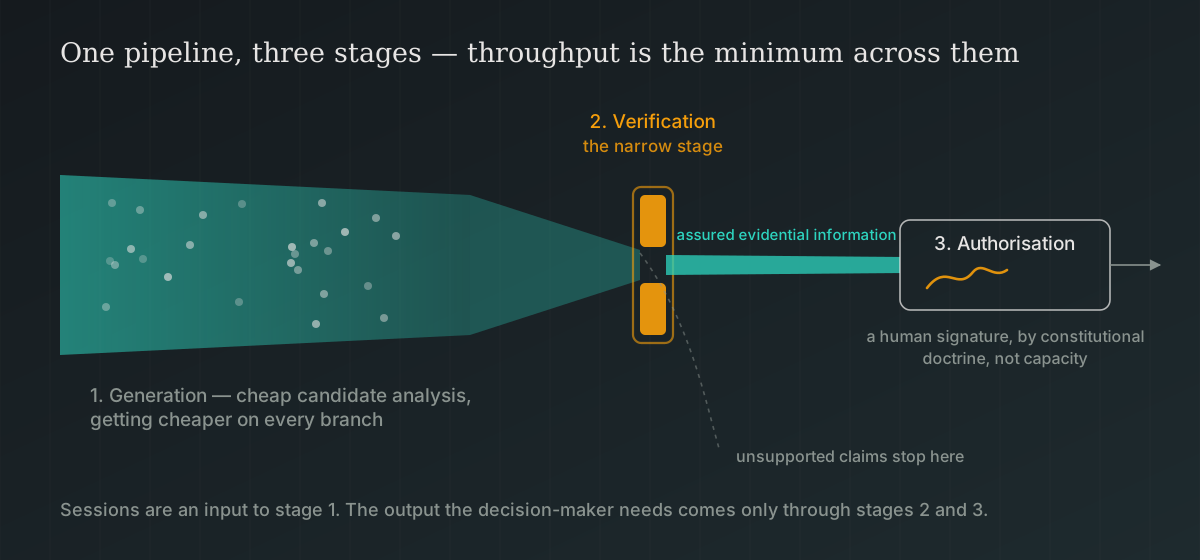
This framing has formal backing. Yang and colleagues prove that the performance of multi-agent systems is capped by intrinsic task uncertainty (the uncertainty the answer retains given the input), and that the relevant bounds are governed by the number of effective channels, not the raw call count. Sessions are an input. The binding constraints live elsewhere, and the next section names them.
Four bounds on useful scale
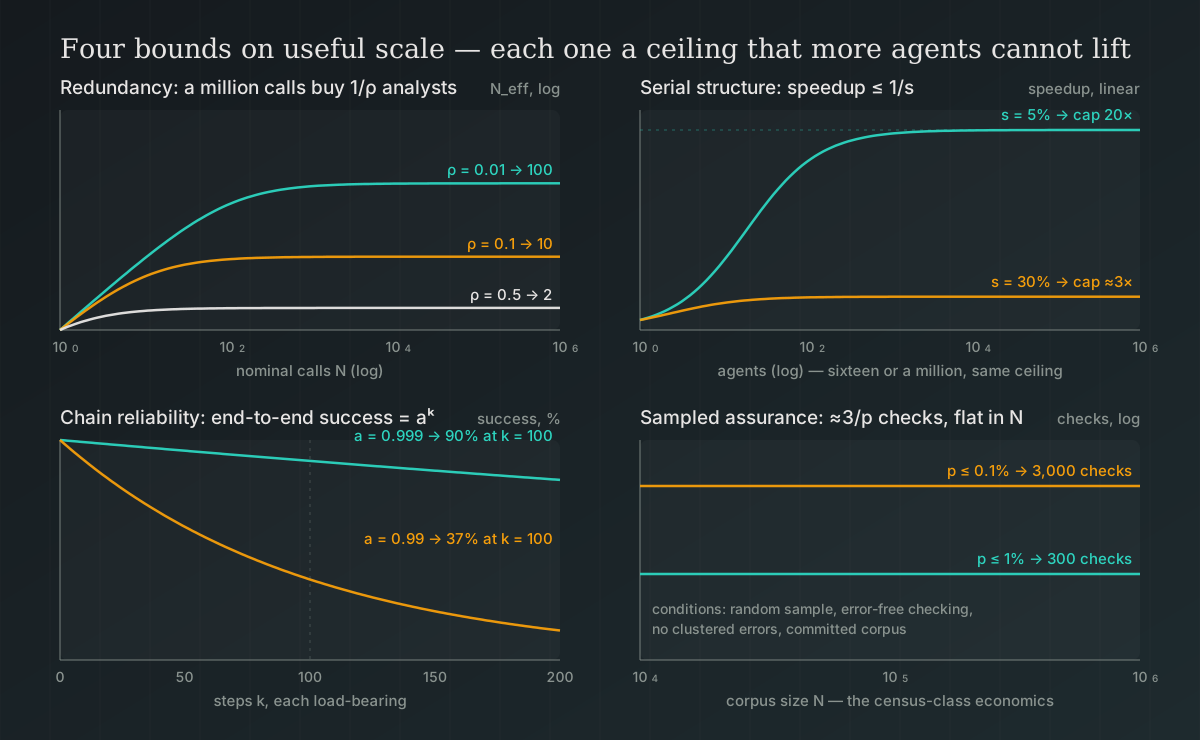
Redundancy: a million calls buy 1/ρ analysts
When agent outputs are redundant estimates of the same quantity, with errors correlated at pairwise level ρ, the Kish design effect converts N nominal observations into N_eff = N/(1+(N−1)ρ) effectively independent ones. The model is an idealisation (equal correlation, comparable variances, an averaging aggregator), and real deployments are messier in ways that can cut either direction; what the idealisation supplies is the cleanest available statement of the ceiling's shape. As N grows, N_eff converges to 1/ρ no matter how large N becomes. At ρ = 0.01, a million calls carry, for averaging purposes, the weight of one hundred independent opinions. At ρ = 0.1, ten. At near-total correlation, one.
This is not a theoretical worry. Bertalanič and Fortuna imported this machinery into the multi-agent literature, derived a two-parameter scaling law from the Kish design effect, and found that thirty densely debating agents produce no more answer diversity than one on MMLU-Hard. Within their tested configurations, only architectural diversity (genuinely heterogeneous teams) lowered the correlation floor. Changing how the agents communicated did not, and much of the apparent benefit of "debate" came from re-evaluation rather than peer content, since a noise placebo tracked self-correction.
Two further results close off the cheap escapes. Goel and colleagues find that model mistakes are becoming more similar as capabilities increase, which points to a correlation floor across model families that rises as models improve. And in Kim and colleagues' study in Nature Machine Intelligence, a preliminary heterogeneity check found no evidence that mixing model families bypasses the saturation threshold; their centralised heterogeneous configurations underperformed strong-model homogeneous ones by a mean of 12.6 percentage points.
The bound has one honest escape, and it is the important one. It applies to redundant answers to the same question. If a million episodes each address a different subquestion — different documents, different data pulls, different code paths — the Kish algebra does not bite, because the episodes are not estimates of a common quantity. Architecture determines whether a deployment sits in the voting regime, with its ceiling of 1/ρ, or the coverage regime, whose ceiling is set by the corpus. It selects the regime; it does not lift the ceiling.
Serial structure: Amdahl's law with agent-team evidence
If a fraction s of a task is inherently sequential, no number of agents delivers speedup beyond 1/s. At s = 5 per cent the cap is 20×; at s = 30 per cent, about 3×; sixteen agents or a million, the ceiling is the same.
The Anthropic compiler project supplied an unusually clean illustration. When its parallel agents reached the Linux kernel, every agent hit the same bug, fixed it, and overwrote each other's changes. Sixteen agents did not help, because each was stuck on the same serial obstacle. Progress resumed only when the human operator converted the obstacle into parallel structure, using GCC as a known-good oracle: most of the kernel was compiled with GCC, and only the remaining files with the agents' compiler. Kim and colleagues measured the same structural dependence across domains. Multi-agent performance ranged from +80.8 per cent on a finance task that decomposes naturally into revenue, cost, and market factors, to −70 per cent on sequential planning; their conclusion is that sequential interdependence, not complexity, determines whether coordination pays. Coordination itself has superlinear cost (they fit reasoning turns growing as roughly (n+0.5)^1.72 in the number of agents), so serial structure is punished twice.
Gustafson's counterpoint supplies the escape route. If the workload scales with the machine (more documents, more jurisdictions, more model specifications, instead of deeper reasoning on one thread), the serial fraction of the scaled job shrinks. Policy questions of the form "what does this one causal chain imply" have large s and low ceilings. Questions of the form "what do all 50,000 responses say" have tiny s.
Information: the census class
No amount of processing extracts more information about the world than the inspected sources contain; this is the data-processing inequality, and Yang and colleagues state the formal version. Combined with the correlation bound, the practical reading is that redundant re-reading saturates fast: for extraction tasks, a million episodes over the same 200 documents buy little that a few dozen well-diversified readings do not. (Compute-heavy work on fixed inputs, such as proof search or counterexample hunting, is a real exception, but it draws out logical consequences of the sources, adds no new information about the world, and is not what mass policy-agent proposals describe.) Mass episodes earn their keep only when the corpus is vast relative to human reading bandwidth, so that agents function as extraction machinery rather than extra opinions.
Call this the evidence census: one episode, or a small tree of episodes, per source object, over corpora of 10⁴ to 10⁶ objects — every consultation response, every local plan, every published trust account, every Hansard column bearing on a question. The census is of a declared, frozen corpus: what is unpublished, restricted, or unknown to the assembly stays outside, and an honest census says so. The Consult deployment is the census prototype at 5×10⁴ objects. Census workloads are exactly where very large episode counts are arithmetically and epistemically coherent: the episodes are parallel by construction and bounded by a corpus large enough to justify the count. Distinct documents are not automatically distinct evidence — campaign duplicates, template-built plans, and shared underlying datasets make a corpus's effective information smaller than its object count — so a census must measure that dependence rather than assume it away. The strongest defensible version of a million agent sessions on one policy question is not a million agents deliberating; it is a census over the question's entire documentary base, with a thin synthesis tree on top. Outside the census class, the correlation and serial bounds cap useful scale at numbers closer to the multi-agent literature's tens, with the logistic saturation past 1,000 agents reported by Qian and colleagues marking about the furthest documented point between.
Reliability: chains, and why the verifier is load-bearing
When a chain of k steps stands only if every step holds, and each step holds with reliability a given that its predecessors did, end-to-end correctness is a^k. At a = 0.99, a 100-step chain succeeds 37 per cent of the time. At a = 0.999, 90 per cent. Retries, tests, and checkpoints can break out of this decay, but each of those is itself a verification mechanism. Long-horizon autonomy is a verification problem wearing a capability costume.
The compiler project's author reports that the task verifier had to be nearly perfect, otherwise the agents would solve the wrong problem, and that most of the human effort went into tests, build scripts, and continuous integration rather than into the agents. Kim and colleagues measured the failure side of the same mechanism: architectures without centralised verification propagated errors at up to 17.2 times baseline, against 4.4 times for centralised designs whose validation bottlenecks intercept errors before aggregation.
Two cautions attach. METR's time horizons are measured at 50 per cent success; policy use requires far higher reliability, so operational horizons for unchecked chains are much shorter than headline horizons. And the Goel result warns that using models to verify models recovers less than it appears, because their errors increasingly coincide. The strong form of verification is a mechanically independent oracle — a compiler, a re-computation, a source-document hash — not a second opinion from a statistical cousin.
What the trajectories actually support
Prices. Decompose cost-per-task into price-per-token × tokens-per-task. At fixed capability, both components fall: Epoch AI's series shows declines of 9× to 900× per year with a median of 50×, and a post-January-2024 subset median of 200× per year, with Epoch's own evaluation-cost cross-check closing the loophole that token counts might be rising to compensate. A Monte Carlo over those series — a decision aid, not an official estimate — takes as its unit of work a documented real agent session from the compiler project, roughly 70,000 output tokens, about £8 at 2026 prices. Its assumed mixture is deliberately far more conservative than compounding the headline series: an 85 per cent weight on an efficiency regime whose cumulative log₁₀ price decline by end-2030 is normal with mean 2.0 and standard deviation 0.55, and a 15 per cent weight on a friction regime with mean 0.9 and standard deviation 0.30. That gives a median of roughly 475,000 purchasable 2026-capability sessions per £50,000 by end-2030, with an 80 per cent interval of about 53,000 to 2.8 million. Even the pessimistic decile funds a fifty-thousand-episode census. On any parameters in that neighbourhood, purchasing power is not where this argument fails.
Capability. Under METR's TH1.1 update, the post-2023 fit gives a horizon doubling time of 130.8 days, the post-2024 fit gives 88.6 days, and the full-series fit is slower than either. From the January 2026 frontier point (320 minutes), a 40-hour horizon arrives somewhere between autumn 2026 and mid-2027, depending on which fit persists and where in its wide confidence band the truth sits; METR itself reports the trend with caution, noting sensitivity to task composition and wide confidence intervals. The deeper problem is that the measuring instrument runs out first. The implied end-2028 horizon spans 230 to 22,500 hours across the three fitted rates, far beyond a suite in which only 5 of the 31 tasks estimated at eight hours or longer have measured human baselines. During 2027 the doubling law stops being a measurement and becomes a forecast about a construct. Capability growth is real and fast, and about to become unmeasurable by the very trend line being quoted; 2030 claims resting on the extrapolation should carry that label.
Compute. Epoch's crunch analysis expects demand growing around 10× per year against supply growth of 3.4× per year, but concludes that in a crunch, everyday users shift to cheaper models while the largest models are reserved for work that justifies frontier prices, and that tomorrow's smaller models quickly match today's frontier. Fixed-capability census workloads sit in the insulated tier; frontier, long-context, and security-accredited access sits in the exposed one. Wall-clock time is a non-issue: a 70,000-output-token session decodes in about half an hour at interactive speeds, so a million sessions at ten-thousand-way concurrency complete in about two days. The operative constraints are provider quotas, accreditation of secure environments for OFFICIAL-SENSITIVE material, and the independence of what the sessions produce.
None of these trajectories rescues the naive production function. All of them make the pipeline's second stage more binding: generation gets cheaper on every branch, and verification gets cheaper only where somebody builds the machinery that makes it so.
The measured case: verification dominates the cost
The direct evidence is one deployment — a single data point, but the best publicly quantified comparison of generation and checking costs that exists. In the Consult deployment, categorising over 50,000 consultation responses cost £240 of machine time and 22 hours of expert checking. At £50 to £80 per loaded expert hour, assurance was 82 to 88 per cent of the exercise's direct cost, in 2025, before the generation side had fallen further. (Development, integration, and security costs sit outside both terms, and the team also ran separate manual reviews of stakeholder responses outside the measured comparison; the ratio is between the two marginal inputs that scale with volume.) Twenty-two expert hours over 50,000 responses is 1.58 seconds per response: necessarily an aggregate, sample-based audit, not item review. And the machine did not scrape through. Consult agreed with one or both expert groups almost 83 per cent of the time, while the two practised human groups agreed with each other only 55 per cent of the time — an easier criterion than pairwise agreement, so it speaks to usability rather than superiority; its F1 alignment scores were 0.79 and 0.82 against an inter-human 0.74. Machine categorisation aligned with its expert references at least as closely as they aligned with each other (an agreement result against noisy references, not a proof that the machine beats the experts), checked by sampling, with assurance nonetheless dominating the marginal budget. As generation costs compound downward, the assurance share rises mechanically unless the productivity of assurance itself improves. That conditional is what the research programme later in this essay is for.
Sampling theory explains why the verification bottleneck is task-structure-dependent. For homogeneous outputs, the rule of three says that certifying an error rate below p at 95 per cent confidence needs about 3/p clean sampled checks (300 items for one per cent, 3,000 for a tenth of a per cent), independent of corpus size. Assurance of census outputs therefore scales with the required error bound, not with N. The rule carries conditions worth stating plainly. The sample must be random; the sampled items must be classifiable without error; and errors must not cluster in strata the sample is unlikely to reach, which is where an adversary, or an unlucky prompt template, will concentrate them. An average error rate is also not always the right target, since one fabricated quotation can matter more than a thousand harmless misclassifications; risk-weighted and stratified designs appear in the research agenda below for that reason. What does not sample at all is the unique heterogeneous chain: a single deep synthesis whose steps each need bespoke checking, where a^k decay makes per-step verification mandatory.
So the bottleneck localises, and it localises on a verifiability stack:
- Extractable facts and citations: machine-checkable — the source is hash-frozen so it cannot drift, and the claim is resolvable to the passage that is supposed to support it. (The hash proves the source has not changed; whether the passage entails the claim is a semantic check, and automating that honestly is one of the research problems below.)
- Statistical claims: re-computable from frozen data by deterministic replay. Replay certifies that the computation produces the stated number; whether the computation was the right one remains a human question, but a much cheaper one.
- Causal and identification claims: partially formalisable, as rank conditions, null-space certificates, and countermodel searches. The algebra can be certified; the substantive assumptions that give it causal meaning cannot.
- Framing and value judgements: not delegable. Machines can map stakeholder positions and expose trade-offs, but no schema converts a value choice into a checkable claim.
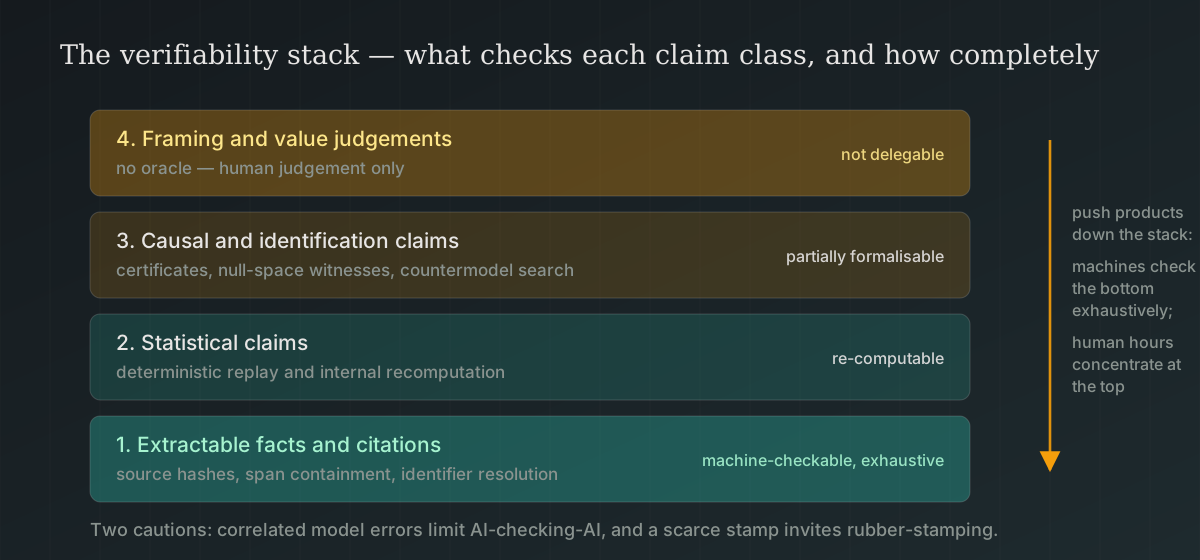
Government's leverage point is to push analytical products down this stack (schema-level claims, source receipts, deterministic replay) so that scarce human assurance concentrates where only humans can supply it. Two cautions attach. Correlated model errors limit how much AI-checking-AI recovers. And once assurance is the scarce stamp, Goodhart pressure to rubber-stamp becomes the failure mode to design against.
The argument that does not need the forecast
Everything above conditions on government adopting agents. The strongest reason to build assurance infrastructure does not.
Mass fabrication of public evidence did not wait for cheap frontier agents. The New York Attorney General's investigation established that nearly 18 million of the more than 22 million comments the FCC received in its 2017 net-neutrality rulemaking were fabricated. That total includes 9.3 million fake supporting comments mostly submitted by a single 19-year-old using automated software, and an industry campaign that paid roughly $4.2 million for 8.5 million comments: about 49 cents each, pre-LLM, for text of template quality. Text generation is now three to four orders of magnitude cheaper and individually styled — though the 49 cents bought identities, submission infrastructure, and campaign organisation as well as prose, so cheap generation shifts an attacker's costs rather than deleting them. Whatever a department decides about running agents itself, the evidence channels it receives through — consultations, calls for evidence, correspondence — face this at scale. That some of this is already arriving is hard to doubt; the forecastable event is detection and documentation. A documented UK case by end-2029 is assessed here at 0.65 — a calibrated judgement offered for the record, not a measurement, with no comfortable reference class behind it and documentation rather than occurrence as the stated crux.
This is what makes the recommendation robust. If the capability forecasts hold, government needs assurance infrastructure to use agents at scale. If they fail, government needs much of the same infrastructure to defend its evidence channels against everyone else's agents. The overlap between the two problems is real but partial, and it pays to be exact about it. The shared core is provenance and sampled audit: receipts for how evidence was produced, frozen corpora, and statistical machinery for certifying error rates over large collections of documents nobody will read in full. Internal use additionally needs replay and claim schemas. Inbound defence additionally needs submission provenance and campaign transparency, together with identity machinery whose costs to anonymous participation have to be designed for explicitly. How large the shared core is as a fraction of either branch's budget is not quantified here, and a serious budget would have to measure it; what is not speculative is that commitment, receipts, and sampled audit appear in both columns. The forecast changes how soon and how much; it does not change whether the shared core is needed.
The recommendation also lands on existing scaffolding. The UK's roadmap to trusted third-party AI assurance already commits government to professionalising the AI assurance market: a skills framework, an £11 million AI Assurance Innovation Fund from spring 2026, against a market of over 524 firms worth about £1.01 billion in 2024 and projected at £18.8 billion by 2035. That programme assures AI systems — the models and the processes around them. The gap is assurance of AI-generated evidence products: claim schemas, frozen corpora, citation resolution, replay commands, sampled human audit, and an inbound-evidence provenance requirement. Extending the roadmap's machinery from systems to evidence products is a bounded, fundable act. The cost worth admitting is standardisation risk, since schemas fixed in 2026 can ossify around 2026-shaped outputs; the mitigation is to version the standards, sunset them, and pilot before mandating.
The research programme: making assurance cheaper, simpler, and more capable
If the first half of this essay is right, the productivity of assurance is the variable that matters most, and it is a research target. What follows is a survey of the avenues that would move it, organised by the part of the problem each one attacks. Much of this is not new science. It is mature machinery from other fields — election auditing, laboratory proficiency testing, tax administration, software verification, survey statistics — that has never been pointed at AI-generated evidence.
Measure the unknown numbers first
The argument above runs on quantities nobody has measured. The cross-model error correlation ρ on policy-analytic tasks is the single most valuable unknown number in the field — valuable as an instrument and a first reading, since the number itself dates with every model generation: every published correlation result comes from benchmarks like MMLU-Hard, whose item structure looks nothing like consultation coding or identification appraisal. Measuring it properly needs a fully crossed design (items × model families × prompt replicates) analysed with variance components, so that shared item difficulty is separated from genuinely shared model error. The same study should measure the conditional quantity that governs how much machine pre-screening can safely displace human hours: the probability that a machine verifier passes a claim given that the generator got it wrong. Bertalanič and Fortuna report that scaling-law parameters fitted on pilots of five agents extrapolate to thirty, which would mean a department could establish which regime it is in — hard ceiling, sublinear, or coverage — for a few thousand pounds, before committing to any architecture. That claim also needs testing on policy tasks rather than benchmarks.
The same goes for the shape of the work itself. Nobody knows what fraction of the claims in a real UK impact assessment or consultation summary is mechanically checkable, what fraction is re-computable, and what fraction is irreducibly judgement — by count, and separately by weight on the product's conclusion, which is the number that matters. Nobody publishes the assurance share of analytical cost, because generation arrives as an invoice while assurance arrives as staff time that was already being paid for; without a cost taxonomy and a time-use instrument, the 82–88 per cent figure remains a single data point from a single deployment. And nobody publishes a constant-work price index: the cost of a fixed basket of policy-analytic tasks at fixed acceptance thresholds, re-priced quarterly. The wedge between that index and the per-token series is the number a four-year business case needs. These are measurement exercises, not theory. They are cheap, and everything else in this programme calibrates against them.
Sharpen the statistics of audit
The rule of three is the crudest tool available, and better ones already exist. Election auditing has spent two decades building risk-limiting audits: sequential tests that certify an outcome with a guaranteed maximum probability of wrongly certifying, hand-checking as few items as the evidence permits and escalating automatically when the evidence resists. The betting-martingale forms of these tests stop early when quality is high, which is the modal case for census-class extraction. The saving has a precise home, and it is worth naming: in two-point acceptance designs, which certify against a declared acceptable-quality and limiting-quality pair, sequential plans reach the same operating characteristics with average sample sizes 40 to 60 per cent below matched fixed-size plans. Against the zero-defect rule-of-three bound on its own worst-case ground there is little slack to win, so an audit design must say which game it is playing. Porting that machinery to evidence products, with defects audited instead of miscounted ballots, is statistical engineering rather than a research gamble.
Three further upgrades compound it. Stratified allocation exploits the verifiability stack: citations cost seconds to check and estimated statistics cost hours, so optimal allocation of a fixed expert budget differs from flat sampling by a large and computable factor. Prediction-powered inference attacks the estimand rather than the items. It combines machine labels on the whole corpus with human labels on a small random subsample to produce confidence intervals for the published figure — "62 per cent of respondents opposed" — that remain valid whatever the machine's prediction errors (provided the human subsample is genuinely random, its labels sound, and the estimand fixed in advance), with interval width set by human–machine disagreement instead of raw machine accuracy (Angelopoulos and colleagues, Science, 2023). Conformal risk control does per-item triage with guarantees that need no distributional model, though not no assumptions: calibration and deployment must be exchangeable, or the gap between them explicitly bounded. Score every claim, calibrate a threshold, auto-accept above it, route the tail to humans, and under those conditions the false-claim rate in the auto-accepted set is certified in advance (Angelopoulos and colleagues, 2024). The caveat on the last is that everything depends on score quality, and the correlated-error results cut against optimism here: machine scorers may be least informative on the items the generator got confidently wrong.
Two corrections keep all of this sound. Every published sample-size formula in this space assumes the human checker catches every defect they inspect. Real reviewers do not, and if auditor sensitivity is s, zero findings in n checks certifies only an error rate below approximately 3/(n·s), an approximation that itself assumes constant, independent reviewer sensitivity. The correction machinery exists (imperfect-test corrections in epidemiology, capture–recapture across independent reviewers in software inspection), and nobody has estimated s for evidence assurance. The second correction is temporal. A certified rate is a statement about a frozen configuration; model versions, prompts, and submission populations all drift, so certification needs the sequential change-detection layer that industrial quality control has had for seventy years, tuned so that a doubling of the error rate is caught within a stated number of audited items at a stated false-alarm rate.
Build mechanical oracles, and type every claim by its refuter
The verifiability stack becomes infrastructure the moment claims carry their checking obligations explicitly. A claim schema in which every assertion states its type and its oracle — a source hash and byte span for a quotation; data, code, and tolerance for a computed statistic; a graph and query for a causal claim; an explicit NONE for framing and values — changes the economics of assurance structurally. Within machine-checkable strata the oracle runs exhaustively at near-zero marginal cost, and the entire human budget concentrates on the strata where no oracle exists. The residue becomes visible instead of hidden.
Each oracle class is worth taking apart. Citation checking is three checks, not one: the identifier resolves; the retrieved bytes hash to what was frozen at corpus freeze, which catches silent revision of legislation, statistical releases, and web pages; and the quoted span is actually contained in the source. Measurements of deep-research agents make the ordering quantitative (Cited but Not Verified, 2026). Link validity runs 94 to 100 per cent while claim support runs 39 to 77 per cent, so the check everyone builds first, whether the URL resolves, is the one with almost no discriminating power, and the gap between "the source exists" and "the source supports the claim" is where the checking effort belongs. Deterministic replay splits the same way, into full replay, which needs the data and the code, and oracle-free internal recomputation, which needs only the document: re-deriving a percentage from its own numerator and denominator, checking that shares sum, that stocks reconcile with flows, that a reported statistic is arithmetically attainable. The statcheck programme found that roughly half of published psychology papers contain at least one internal reporting inconsistency, using nothing but the papers' own text. Internal recomputation is the one oracle in this inventory that works on adversarial inbound evidence, because it requires nothing from the author.
Further up the stack, some causal and rule-mechanics claims admit genuine decision procedures. For well-specified graph and query classes, nonparametric identification is decidable, with algorithms that return either an estimand or a certificate of non-identifiability — always conditional on a graph the algorithm cannot itself certify. That machinery is already operated by the Policy Identification Observatory at stage 5 of its case protocol, the identification gate. Linear-model non-identification has exact null-space witnesses. Claims about what a rule system does — effective marginal rates, cliff edges, who loses more than £X — can be checked exhaustively against executable encodings of the tax-benefit system with an SMT solver, which returns either a proof over the declared domain or a concrete counterexample household — a proof about the encoding, whose fidelity to the statute is the trust boundary human review must hold. Exhaustive checking has no sampling error, so the rule of three simply does not apply to that stratum. The deepest version of this is proof-carrying analysis: the producer ships a witness, and the consumer runs a small checker in exact arithmetic: a few hundred to a couple of thousand lines with no model inside — the smallest thing that needs trusting, though not the only one, since the theorem statement, the encoding, and the toolchain stay in a trust base the kernel shrinks but cannot delete. That structure is the one approach in this programme that is immune to the correlated-error problem, because it removes the second model opinion from the loop entirely. Its limit is coverage: witness formats exist for a handful of claim classes, and most statistical estimation will never have one.
Make sampling sound: commitment before audit
There is a soundness gap beneath all sampled assurance, and it is cryptographic rather than statistical. The rule of three certifies the population the sample was drawn from. If the operator can re-generate, silently repair, reorder, or selectively present items after learning which ones the auditor will inspect, three hundred clean checks certify nothing; a curated-corpus attack can pass a 1 per cent audit while the true error rate sits an order of magnitude higher. The repair is standard in adjacent fields and absent in this one. The operator publishes a signed Merkle commitment over the frozen corpus and all outputs before the sample is drawn; sample indices come from a public randomness beacon the operator cannot steer; every audited item is served with an inclusion proof against the pre-committed root. The commitment costs a 32-byte leaf per item; each audited item then carries an inclusion proof of a few hundred bytes of sibling hashes. Commitment also has a boundary worth stating plainly: it certifies that nothing changed after the freeze, and nothing about what was frozen. Selection attacks run before commitment (an inconvenient document omitted, a population boundary drawn kindly), and the repairs are institutional as much as cryptographic: declared inclusion rules, adversarial search for what is missing, and corpus assembly by a party other than the one being audited. The same primitives extend outward. Signed usage receipts from inference providers turn operator claims about volume and model identity ("200 agents, 15 hours") from testimony into checkable evidence, and append-only transparency logs in the style of Certificate Transparency turn equivocation and backdating from deniable into detectable. The analogy also breaks in one instructive place: certificates have a motivated victim who monitors the log, and evidence products mostly do not, so the monitoring function has to be designed and funded rather than assumed.
Two deployment facts matter for government. Privacy law is the binding constraint on append-only designs, and there is a candidate repair: log keyed commitments instead of content, so that erasure is executed by destroying a key while the log's integrity survives. This is a design pattern, not settled law — commitments, timestamps, and linkage metadata can remain personal data in the wrong architecture, and a real deployment needs the full legal design — but it is the difference between a proposal that dies at the impact-assessment stage and one that arrives there with answers. And trusted-execution attestation is strong in an unglamorous place: attesting the orchestrator (corpus freezing, sample derivation, deterministic scoring) is deployable now on commodity cloud and covers the steps the commitment protocol needs, while attested frontier inference remains vendor-dependent. Replay bundles tie the layer together as the unit of publication: content-addressed corpus, pinned environment, signed receipts, per-claim anchors, and a declared conformance class. Agent pipelines are not bit-reproducible, so the classes must distinguish "the checks reproduce every verdict" from "the bytes match"; the former is the property assurance actually needs. And the infrastructure is itself an attack surface with its own required threat model: signing keys can be compromised, source corpora poisoned before the freeze, replay bundles crafted maliciously, transparency-log metadata mined for what it reveals. Provenance buys integrity partly by spending confidentiality, and that exchange rate has to be set deliberately rather than discovered in an incident.
Defend the inbound channel by provenance, not detection
For the channels government receives evidence through, one design decision matters more than the rest: detection of machine-generated text is a losing game, and the programme should be built provenance-positive instead. The negative result is now theoretical as well as empirical, since detector performance is bounded by the shrinking statistical distance between human and model text. Its failure mode is also the worst available, because false positives concentrate on non-native English writers and unusual styles. In UK public law that is not a mere tuning parameter. Consultation responses must be conscientiously considered; excluding genuine responses because a classifier misfired invites judicial-review challenge, with how far any particular exclusion is justiciable turning on materiality and context; and a screening regime whose errors track protected characteristics raises questions under the equality duty that no accuracy figure settles. A consultation-defence design that quietly discards flagged submissions is courting legal risk rather than building a safeguard.
The provenance-positive alternative assembles pieces that mostly exist. Attested submission channels with rate limits. An optional verified-identity tier alongside an open one, so that authentication buys signal without excluding anyone. A signed declaration of AI involvement, useless against adversaries but valuable analytically, because it creates an honest stratum and makes the dishonest one a measurable residual. Mandatory campaign disclosure by organisers, for which the Elections Act 2022 digital-imprints regime is a working domestic precedent. Watermark checking where generators cooperate (production-scale text watermarking is deployed, though opt-in by construction). Beneath all of it sits robust aggregation, which may quietly dominate the rest: a consultation is not a vote, so clustering submissions by distinct argument and capping the weight of any one cluster defends the analytical product against volume attacks without adjudicating the authorship of a single response. A cap is not neutral, though: prevalence and mobilisation can themselves be evidence (of salience, of organised interests, of who bears an impact), so capping is a choice of estimand that has to be stated and defended, not a technical default. Whether argument-level aggregation beats any legally tolerable detector is an open empirical question, answerable with a planted-contamination benchmark scored on distortion of the final theme table rather than on classification accuracy. The published object should change accordingly. Alongside its conclusions, a consultation analysis should report the fabricated-submission fraction at which each headline conclusion would flip, so that contamination robustness becomes a stated property rather than an assumption.
Design the institution against Goodhart
Once the assurance stamp is scarce and valuable, the failure mode is rubber-stamping, and the countermeasures are known because older assurance industries learned them expensively. Tax administration found that risk-targeted audits alone are gameable and cannot estimate the population error rate, which is why HMRC runs a random enquiry programme alongside targeted enforcement. An evidence-assurance regime needs the same randomised floor, both for deterrence and because it is the only source of an unbiased estimate of the residual error in stamped products — an "evidence error gap" a Public Accounts Committee could track. Laboratory medicine routes blind proficiency samples through accredited laboratories continuously, because assurers must themselves be assured; planted-defect items in the live assurance queue measure the gap between announced-audit and blind detection rates, which is the rubber-stamping rate observed directly. Financial audit, for its part, shows what a binary stamp does to incentives, which argues for replacing pass/fail with a published operating characteristic: a machine-readable receipt stating what was checked, by which oracle, at what certified bound, and what was never covered at all.
The market lever is procurement, which moves in months where legislation moves in years. Three clauses insertable into existing contract vehicles would do most of the work: a replay clause delivering frozen corpus hashes, model identifiers, and a deterministic replay command; an assurance receipt as a named deliverable; and third-party audit access, explicitly including blind proficiency items. A market cannot form around a good that cannot be independently inspected, so the replay clause is the precondition for extending the third-party assurance market from systems to evidence products. Against the ossification worry, the same empirical habit applies as everywhere else in this programme. Schema decay is measurable: apply vintage standards to current products and count what no longer fits, with reporting standards in other fields supplying decades of revision history as the outside view. Sunset clauses can then be set from a measured decay rate instead of taste.
Spend assurance where the decision needs it
Nothing above says how much assurance a given product warrants, and a uniform answer would be wrong in both directions. The right depth of checking is a decision-theoretic quantity. It depends on the stakes, the reversibility of the decision, the cost of delay, and the relative harm of false confidence and false alarm; a benefit-entitlement rule and a low-stakes theme table should not share an assurance budget. That allocation problem is a research avenue in its own right — expected-loss-driven verification depth, with disclosure of unresolved uncertainty priced as an alternative to resolving it. The programme should also be priced against the simpler substitutes that capture part of its value: stronger reproducible-pipeline practice, representative surveys where open consultation volume is the real problem, random human audit with post-publication correction, procurement warranties, plain staffing. Some of those win at some stakes. An assurance programme that cannot say where they win does not yet know its own value.
The assurers themselves need more governance than a proficiency test. Conflicts of interest, auditor shopping, liability for wrong certificates, appeal routes, and revocation are design problems that blind testing measures but does not solve — and financial audit, the nearest mature analogy, is a warning as much as a template, since formal independence rules have not eliminated correlated institutional failure there either.
The theoretical core: a calculus for assured claims
Everything in the programme above shares a missing foundation. Each instrument certifies one kind of thing: a sampled error rate, a replayed number, a resolved citation, an identification witness. What no existing framework answers is the operational question a recipient actually faces: given an output produced through many sources, models, tools, transformations, and reviews, what may I safely rely on, under which assumptions, with what residual risk, until when, and under whose authority? The world's existing infrastructure covers the adjacent layers. Verifiable-credential standards authenticate who issued a claim and whether it was tampered with; content-provenance standards record where an artefact came from and how it was edited; structured assurance-case standards (OMG's SACM, the Turing Institute's assurance platform) carry claims, arguments, and evidence, though without frozen sources, replay, or statistical residual-risk machinery; agent-standards work at NIST covers identity, authorisation, and interoperability; ISO/IEC 42001 certifies organisational management systems. None of these establishes that a conclusion follows from its evidence, that its assumptions are adequate, or that it is fit for a particular decision. That semantic and epistemic layer is the main missing piece of assurance infrastructure worldwide, and its formal core is theory — which means, as of this year, the buildable part of it is machine-buildable.
The claim that theory is now a fast lane is not speculative. On 1 August 2026, OpenAI published ten advances in mathematics and theoretical computer science produced by an internal model, Astra — among them a construction it presents as the first explicit non-sofic group, a question open since 1999 — with the published solution runs costing roughly $2,000 in tokens and the results released as machine-checkable proofs. The detail that matters here is not the capability but the trust architecture. Acceptance does not rest on the lab's word: each formal proof is checked by Lean's small, mechanically independent kernel, and the review left to human mathematicians is the genuinely human residue — whether the formal statements faithfully render the informal problems. Frontier generation, a tiny trusted checker, human scrutiny concentrated at the semantic boundary: that is this essay's argument running at the frontier of mathematics, and the same machinery can build the assurance layer itself. The window in which building it is a deliberate choice, rather than a scramble behind deployed capability, is not wide.
The foundation would be a compositional assurance calculus: a small trusted kernel, not another framework document. Its central object is an assurance record that travels with a piece of analysis, carrying a typed graph of claims and the inferences between them, source provenance, verification artefacts, declared dependence, temporal validity, authority, and unresolved objections. Claims carry types — a quotation, a measurement, an accounting identity, a deterministic computation, a statistical estimate, a causal claim, a forecast, a recommendation, a value judgement, an authorisation — so that valid arithmetic cannot silently become a valid causal conclusion, and evidence that something is true cannot silently become authority to act on it. Over that structure sits a short theorem package: a certificate follows only from certified premises and admissible rules; unverified evidence cannot become verified by passing through more agents; duplicated or paraphrased evidence adds no independent support; an unresolved critical objection never strengthens a certificate; truth confers no authority; and where a certificate cannot be constructed, the checker must say so — conditional, abstain, or rejected, never a shrug. Three layers have to be kept distinct here, because only one is kernel-checkable: that a certificate follows from formalised premises, which is provable; that the formalisation faithfully encodes the actual evidence and inference, which is inspectable — and the calculus's job is to make it small enough to inspect; and that the whole is adequate to a real decision, which stays human. The antecedents for the provable layer exist: structured assurance arguments with explicit defeaters on one side, and recent tool-attested kernel-proof work showing bounded empirical claims verified end-to-end on the other. What is missing is the calculus that joins them, with machine-checked soundness and a schema two independent teams can implement without talking to each other.
Four supporting theories complete the core, each turning something the earlier sections treated as practice into something provable. Dependence: replace a single correlation number with partial-identification bounds on the probability that every verifier fails together — the upper bound, not an independence assumption, governing certification — plus impossibility results showing when no quantity of voting or debate can reach a stated assurance level. Those theorems would stop organisations buying cosmetic redundancy, and measured error correlation across hundreds of models says the market is currently buying a great deal of it. Auditing: anytime-valid stopping certificates for evidence censuses, so that auditors who target suspicious documents, inspect results as they arrive, and stop when convinced still carry a bounded false-certification probability; with graded release states (certified, certified within conditions, human review required, unresolved, rejected) in place of a pass/fail stamp. Time: certificates as versioned conditional objects — bitemporal claim graphs separating when a fact held from when the organisation learned it, an invalidation calculus that propagates source corrections and silent model swaps through the dependency graph, and a minimal-revalidation theorem identifying the smallest re-audit that restores an assurance grade after a change. Measurement: a multi-component assurance vector (coverage, residual risk, dependence exposure, freshness, abstention, authorised scope among them) with a proof that no single trust score can summarise it faithfully, and a planted-case benchmark that rewards correct refusal and correct scope limitation as much as correct answers.
Scored by the same panel, under the same doctrine, the five core programmes land differently from the instruments — and the difference is itself the finding.
| # | Medal | Programme | P | Payoff | Horizon | Indicative cost |
|---|---|---|---|---|---|---|
| T1 |  | Anytime-valid auditing of evidence censuses: stopping certificates and graded release | 0.33 | 0.61 | 12 mo | ~£285k |
| T2 | | Dependence-robust verification portfolios: bounds, diversity certificates, impossibility results | 0.32 | 0.72 | 12 mo | ~£260k |
| T3 | | Temporal assurance and minimal revalidation: an invalidation calculus | 0.30 | 0.66 | 15 mo | ~£330k |
| T4 | | The compositional assurance calculus: a typed algebra for evidential information | 0.22 | 0.81 | 14 mo | ~£365k |
| T5 | | Assurance measurement science and the adversarial planted-case benchmark | 0.20 | 0.52 | 15 mo | ~£300k |
A scoring note first, because the numbers are easy to misread. P for these five measures delivery of the stated gates, and the gates deliberately include partial proxies for external validity (non-vacuity on real cases, independently built implementations that must interoperate), so the published probabilities price the formal work and part of the mis-carving risk together. What P cannot price, payoff carries: whether a gate-passing calculus is the one the world adopts. The panel's scepticism is precisely located, and it is not about the labour. Every judge agreed that agents deliver the Lean developments, the schemas, the reference checkers, the simulation grids, and the counterexample searches. The probability mass sits on building the wrong thing, not on failing to build: a calculus whose type system mis-carves real disputes passes every internal gate and answers a question nobody asked; a stopping certificate quantified over a population boundary the audited party drew is impeccable and empty; an invalidation calculus cannot see the silent model swap that motivates it unless an attestation channel exists outside the mathematics; a benchmark's planting recipes become training targets the day they publish. These are definitional risks, and definitional iteration is human work no agent compresses.
That changes the funding logic. When formal labour cost person-years, a foundational calculus was a bet an institution placed once, carefully, after committees. At agent costs (all five programmes for roughly £1.5m, every mechanical stage parallelisable) the sensible structure is staged rather than simultaneous. Start the calculus's definitional work and the two least-coupled programmes, dependence bounds and census auditing, immediately; tranche the temporal calculus and the benchmark on the claim ontology settling, because the five share one common-mode risk: a mis-carved ontology damages the auditing estimand, the freshness semantics, and the benchmark labels together, and five tickets on one flawed definition is not diversification. Cheap formal iteration burns through wrong definitions quickly; the human argument about what the types should mean is the schedule-critical path, and staging stops the portfolio inheriting its failure. The calculus itself is the sharpest case: nearly the least likely project in this essay to deliver as specified, and, at a payoff of 0.81 against the portfolio's joint-highest 0.82, very nearly the most valuable if it does. Portfolios exist for exactly this shape.
Sixteen projects, ranked by probability of delivery
The avenues above decompose into specific projects, and the decomposition was done under discipline: each project below is sized for a small team, carries a pre-registrable resolution criterion that can fail, and was scored three times in isolated passes (a calibration-focused forecaster profile, a sceptical methodologist profile, and a research-strategy profile focused on supersession), with the median taken. The projects are stated so that any funder or laboratory in any jurisdiction could carry them forward: the methods are general, and where a criterion needs a concrete corpus or institution, a workable example is named. In dependency order the theoretical core above comes first: several of the instruments below — the coverage census, the audit machinery, the citation receipts — become components of its certificates the moment the calculus exists.
The scoring assumes something the essay has been arguing all along: that the agents are already good enough to do the mechanical share of the research. Corpus assembly, annotation at scale, statute encoding, proof search, simulation, implementation: in every project below, agents execute that work now, directed by a small human team, and the horizons and costs reflect it. Most of the portfolio fits inside a year and under £100k a project. What does not compress is the human critical path: expert judgement where humans are the instrument, institutional hosting, contracted adversaries, and calendar time itself. One apparent circularity is worth naming and closing. A programme whose thesis is that unassured agent output is not useful work cannot simply count agent output as completed research — and it does not: every project gates on artefacts something other than an agent's say-so can certify, machine-verified proofs, blind human adjudication, interoperating independent implementations, pre-registered statistical gates. Expert review of agent-built artefacts is real work and the cost bands carry stated review budgets; what they exclude (overheads, security accreditation, data licensing, contingency) makes them lower bounds on full economic cost, with each project's cost composition recorded alongside its criteria in the machine-readable record linked below. The same doctrine cuts the other way on value. A result that lands in months arrives in roughly the world it measured; anything slower must survive model turnover, so payoff is scored for the world in which the result lands. Measurements of current-model behaviour decay within a model generation. Theorems, protocols, standards, checkers, and reference corpora do not. The ranking that follows therefore favours exactly what a research funder should currently favour: durable instruments that agents can build immediately.
P is the probability that the project delivers its stated resolution criterion within its horizon, given a small human team directing capable agents. It is not a measure of importance. Payoff, scored separately, is an ordinal 0–1 judgement of how much the result would advance assurance infrastructure conditional on delivery, in the world where it lands, anchored so that 0 means practice is left unchanged and 1 means a binding constraint is removed across the field; it is an expert scale, not money. Costs are indicative, at 2026 rates, and assume agents do the building. The full pre-registrable resolution criteria, the individual judge scores behind every median, and the scoring definitions are published in this page's machine-readable record. The scores are dated, and they expire: assessed on 4 August 2026, marked for review by 4 November 2026, because a probability scored against this model landscape has the same short half-life as any other measurement of it — the portfolio's certificates expire, like the ones it proposes.
Every project medals, because this is a portfolio rather than a cull:  gold for the near-certainties,
  silver for the better-than-even tier,
  bronze for the coin flips, and
  teal — the house colour — for the hard tail, where much of the value sits. The theoretical core carries platinum: the foundations the rest plug into.
| # | Medal | Project | P | Payoff | Horizon | Indicative cost |
|---|---|---|---|---|---|---|
| 1 | | Curated-corpus attack on sampled assurance, plus the commitment countermeasure | 0.88 | 0.68 | 4 mo | ~£35k |
| 2 | | Replay feasibility audit of published government AI-assisted analysis | 0.80 | 0.55 | 3 mo | ~£30k |
| 3 | | Metamorphic relation library and mutation benchmark for government analytical pipelines | 0.68 | 0.70 | 5 mo | ~£45k |
| 4 | | Risk-limiting audits for evidence products | 0.60 | 0.68 | 6 mo | ~£90k |
| 5 | | Prediction-powered consultation statistics | 0.60 | 0.72 | 4 mo | ~£45k |
| 6 | | The assurance coverage census of real policy claims | 0.57 | 0.82 | 7 mo | ~£70k |
| 7 | | Exhaustive rule-mechanics verification of published tax-benefit claims | 0.55 | 0.65 | 7 mo | ~£70k |
| 8 | | Contamination forensics and fragility bounds for published consultations | 0.52 | 0.45 | 9 mo | ~£85k |
| 9 | | Identification-gate certificates with independent checkers | 0.50 | 0.62 | 8 mo | ~£60k |
| 10 | | PolicyCAPA: measuring cross-model error correlation on policy tasks | 0.42 | 0.55 | 7 mo | ~£150k |
| 11 | | Certified auto-accept: conformal triage and its cost curve | 0.42 | 0.55 | 6 mo | ~£70k |
| 12 | | No-cooperation checker for inbound evidence, scored on theme-table distortion | 0.40 | 0.58 | 8 mo | ~£95k |
| 13 | | Citation receipts with inclusion proofs for versioned public sources | 0.33 | 0.78 | 7 mo | ~£90k |
| 14 | | Coverage estimation and stopping rules for census workloads | 0.26 | 0.55 | 7 mo | ~£70k |
| 15 | | Replay conformance classes for agentic pipelines, with a divergence dataset | 0.25 | 0.60 | 8 mo | ~£60k |
| 16 | | Blind proficiency testing of evidence assurers | 0.16 | 0.82 | 15 mo | ~£190k |
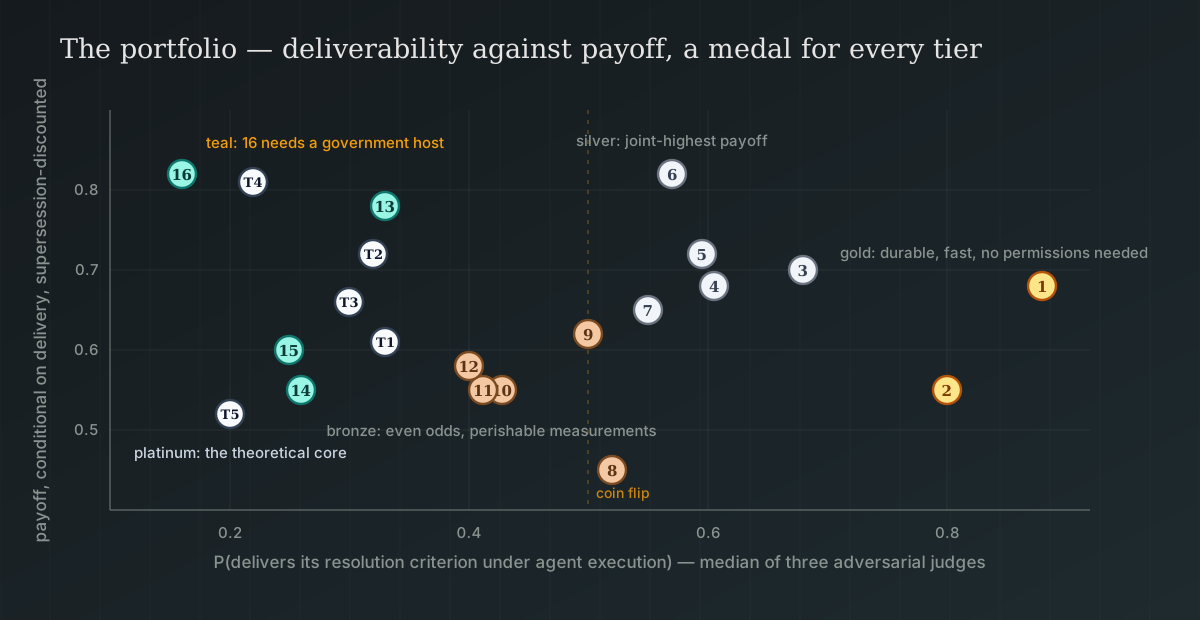
The near-certainties (P ≥ 0.8)
1. The curated-corpus attack (P = 0.88). Formalise sampled auditing as a game in which the operator may repair, reorder, or selectively present items after learning the sample; prove how far a 3/p audit can be fooled; demonstrate it end-to-end on a 50,000-item planted-error corpus, with roughly 300 clean checks certifying an error rate ten times better than the truth; then defeat the same strategy with a pre-published Merkle commitment and beacon-drawn sample indices. Agents do the formalisation, the corpus, the attack, and the countermeasure; the only calendar-bound step is practitioner interviews establishing whether real analytical practice already commits implicitly. Four months. It is also the most durable project on the list: a theorem about an adversary model and a commitment protocol contain no measurement of any model, and the result decides whether every other sampled-assurance project here is sound.
2. The replay feasibility audit (P = 0.80). Take published government analytical outputs that state AI assistance (national algorithmic-transparency registers and the US federal AI use-case inventories provide sampling frames) and attempt third-party replay of their quantitative claims from public materials alone, scoring each on a graded ladder from "sources identifiable" to "numbers reproduced". Because agents absorb the replay labour, the criterion rises from twenty outputs in one jurisdiction to fifty across two, which makes the rung distribution (the actual product) properly readable and cross-nationally comparable. The human critical path is legal review of the drafted replay and audit-access clauses. Three months, desk-based, no permissions needed.
The better-than-even tier (P 0.55–0.68)
3. The metamorphic relation library (P = 0.68). Agents write the invariants for the recurring shapes of government analysis, build the defect catalogue, inject blind, and run all four kill-rate regimes; humans source the defects from documented analytical incidents, which is the step that keeps the benchmark honest. Metamorphic relations for stock-flow accounting and deflation are mathematics and will not expire; only the agent-code-review comparison column decays.
4. Risk-limiting audits for evidence products (P = 0.60). The port of election-audit machinery: assorters, betting-supermartingale tests, escalation logic, and the operating-characteristic curves a department needs to choose a design. Agents implement everything; humans adjudicate ground truth on the benchmark corpora. The drift-detection sub-criterion has already been re-derived once, after review showed the original bar sat below an information-theoretic floor; and the efficiency margin needs the same treatment before registration. Sequential designs beat matched fixed-sample plans when true quality sits inside the acceptable level; against the zero-defect bound on its own worst-case ground they can only tie. The pre-registered benchmark must name which comparison the 40 per cent margin is against, or the criterion is unwinnable by construction.
5. Prediction-powered consultation statistics (P = 0.60). Valid confidence intervals for the published figures of consultation analysis, from machine labels on the whole corpus plus a small random human sample (item-level corpora are published by several regulators and, at vast scale, on the US regulations.gov docket system). The human-labelled subsample is small by design — the human-labelling bottleneck is the method's own subject. The estimator and package are durable; the measured effective-sample multiplier is not — it moves with the model, the taxonomy, and the submission population, in either direction — so a published value is a dated benchmark, not a floor.
6. The assurance coverage census (P = 0.57). Annotate every assertive sentence in roughly sixty real evidence products from at least two jurisdictions against a seven-class obligation taxonomy, elicit which claims are load-bearing, and measure per-class oracle catch rates. This is the project that prices everything else, and it carries the portfolio's joint-highest payoff (0.82): the catch rates are properties of policy prose and versioned substrates, not of any model, so they age on a decade clock. It clears the coin flip it used to sit under for a specific reason — agents can iterate the annotation protocol through dozens of pilot cycles before a single expensive human annotation is spent, which attacks the inter-annotator-agreement gate directly — a real lift, though only human pilot annotation can confirm that gains against synthetic disagreement transfer to human raters.
7. Rule-mechanics verification (P = 0.55). Give published claims about what a rule system does (effective marginal rates, cliff edges, who loses more than £X) formal statements over a declared household space, encode the rules against executable tax-benefit models (the OpenFisca and PolicyEngine families already cover several countries), and return machine verdicts: a proof over the stated domain or a concrete counterexample household. Scored as a long shot when statute encoding meant person-years of human formalisation labour; agents now produce the statute-pinned encoding and the solver harness, the claim floor rises from thirty to sixty, and the binding steps are lawyer review of the encoding, which is the trust boundary, and independent confirmation of at least one counterexample. Durable on a statutory clock, and the harness is reusable against every subsequent reform.
The coin flips (P 0.40–0.52)
Five projects sit near even odds, each held there by something acceleration does not touch. Contamination forensics (8, P = 0.52) gains data access by targeting the docket system that publishes nearly everything, and its fragility-bound half is permanent arithmetic; it carries the portfolio's lowest payoff (0.45) because the other half, detector-based prevalence estimates calibrated on 2026 generators, has the shortest half-life on the list. Identification-gate certificates (9, P = 0.50) is the portfolio's largest re-rating under the doctrine: witness formats, exact rational null-spaces, machine-checkable proofs, and the independent sub-2,000-line checker are precisely the formal labour agents absorb, roughly doubling odds that once sat below one-in-five when humans carried it — while the crux, whether real identification arguments are certifiable at all, is untouched. One caution travels with the re-rating: a proof and a checker can agree perfectly around a shared mistaken specification, so implementation independence has to be paired with independent review of the specification itself. PolicyCAPA (10, P = 0.42) shows the doctrine's other edge. The crossed design and variance-component estimation are now essentially free, but the precision gate is bounded by the double-adjudicated expert gold subsample, which does not compress; and ρ measured on named model versions is the fastest-decaying quantity in the portfolio, which is why its payoff sits at 0.55 rather than the top of the column: the durable assets are the instrument, the harness, and the gold corpus, not the number. Certified auto-accept (11, P = 0.42) keeps its dead zone: an auto-accept fraction between 20 and 50 per cent at policy-grade tolerances remains the most likely landing point, and the coverage-risk curve moves with every capability release. The no-cooperation checker (12, P = 0.40) still hinges on the false-positive rate against genuine public submissions, and its contracted red team is one thing the building agents cannot substitute for: an adversary with a budget and an incentive is not the same agent wearing a different hat.
The hard tail (P < 0.40), where much of the value sits
Citation receipts (13, P = 0.33, payoff 0.78) becomes agent-weeks of engineering in two of its three parts, its second verifier now built by a different model family from the specification alone — implementation independence, which tests the specification's clarity, not the mechanical independence the verifiability stack prizes; it still likely fails its third gate, because the claim-support gap is dominated by semantic non-support that hashes and span checks cannot touch. The spec is a standards artefact all the same: a receipt that verifies in 2026 verifies in 2036. Coverage estimation for census workloads (14, P = 0.26) founders where it always did — themes are not species, and capture–recapture with heterogeneous capture probabilities under-estimates richness beyond the stated tolerance; agent speed does not repair an estimator's bias. Replay conformance classes (15, P = 0.25) meets a critical path acceleration cannot buy: the divergence dataset needs real model-version turnover across real months, and its 95 per cent agreement bar may exceed the human ceiling on judging "substantive conclusion unchanged". Blind proficiency testing (16, P = 0.16, payoff 0.82) remains where payoff and probability part company most sharply. Agents can have the entire instrument (mutation taxonomy, planted-defect generator, shadow queue, control charts) ready before recruitment even closes; everything after that is institutional: hosting, an ethics route with no sector precedent, consenting assurers, live queues with real stamps at stake. The implication lands on institutions, not researchers. This is the project a national assurance programme — the UK's, under its third-party assurance roadmap, or any counterpart elsewhere — should commission, because nobody else can.
Reading the portfolio
Read as a portfolio, the ranking now says something sharper than a sequence. Agent execution compresses almost everything: the whole sixteen-project portfolio costs about £1.26m, roughly what six of these projects would have cost with humans doing the mechanical work, and every project except the institutional one fits inside a year. The near-certainties deliver in about four months for £65k combined; adding the entire better-than-even tier brings the total to under £400k and seven months, and would replace most of this essay's central unmeasured quantities with numbers carrying intervals. What agent execution cannot buy is now the scarce resource in plain view: expert adjudication, institutional hosting, contracted adversaries, and calendar time itself. The supersession lens sorts value the same way. The projects that build theorems, protocols, standards, checkers, and reference corpora hold their worth through model turnover; the projects whose product is a measurement of today's models are already depreciating, and the ranking prices that in — imperfectly, since several mid-table projects mix durable protocol with perishable calibration and a median cannot show the split; the per-project durability notes in the machine-readable record can. A funder reading the list top-down sees durable instruments that agents can build this year. The bottom of the list is closer to a specification of what an assurance programme should itself commission.
The future this argues for
It would be easy to read everything above as a brake. It is closer to the opposite: an account of what has to exist before the accelerator can be pressed.
Properly harnessed, census-class agent work changes what public evidence is. "We considered all responses" stops being a courtesy phrase and becomes a checkable claim with a certified error bound attached. Analytical questions that were never asked because the reading was unaffordable — what do all the local plans, all the trust accounts, all the tribunal decisions actually say — become routine. On the UK government's own estimate, consultation analysis alone consumes some 75,000 analyst-days a year, about £20 million in staffing; the same expertise, redeployed to the top of the verifiability stack, buys judgement instead of transcription. And an evidence product built for verification is a different public object from a report: every citation resolves against a frozen source, every number re-computes on command, and disagreement concentrates where it belongs, on assumptions and values rather than on arithmetic nobody can check.
The deeper point is that assurance productivity compounds. Every claim class that gains a mechanical oracle widens the set of work that can be safely delegated; every widening generates more verified output to learn from; the loop feeds itself. Agents will increasingly check agents — the correlated-error results say that is safe only when the check bottoms out in something mechanically independent, which is exactly what the oracles, receipts, and commitment schemes above provide. Whoever builds this infrastructure first does not just defend against a flood of synthetic evidence; they get to run the census class safely years before anyone else. The advantage is measured in time and earned trust rather than any permanent moat, since standards diffuse — but in a period when capability compounds, years are the currency that matters. The sixteen projects above are how that future gets built on purpose rather than arrived at by accident.
Method and epistemic status
The quantitative claims in the first half — the bound arithmetic, the Consult figures, the price and horizon trajectories, the FCC numbers — come from the published sources linked in the text and collected under Further reading; every derived number was independently recomputed for this essay, and the multi-agent scaling claims are stated within the tested configurations of the studies cited, with flags where a study's reach is narrower than its slogan. The research programme and project list were built for this essay in three stages: four independent research passes over the avenue space (audit statistics, mechanical oracles, provenance and cryptography, institutional design), reorganised into the six avenue sections above; consolidation into sixteen projects with falsifiable resolution criteria; and three adversarial scoring passes under different priors — a calibration profile, a methodological-scepticism profile, and a research-strategy profile focused on supersession — with medians reported, notable disagreements discussed in the text, and every individual score published in the machine-readable record. The passes are prompt-isolated personas, not independent systems: all three ran on the same frontier-model substrate and never saw one another's scores, so by this essay's own dependence argument their medians carry the weight of fewer than three independent judgements. The scoring applies an explicit doctrine, stated in the portfolio section: agents execute the mechanical share of each project now, with horizons and costs revised on that assumption, and payoff is discounted for supersession, so that measurements of current-model behaviour are valued below the instruments, protocols, theorems, and standards that outlive model turnover. The five-programme theoretical core entered by a different route: proposed in an independent cross-model research review, verified source by source, formalised into specifications with machine-checkable gates, and scored by the same panel under the same doctrine. The claim that no existing system assembles the full evidence-product layer is a bounded-search judgement against the prior art named in the text and in Further reading, not a systematic review. This page is versioned in the open: the site repository carries the complete change history, including what changed under each review round. Before publication the essay itself was cross-examined: an adversarial review by a model from a different vendor, an internal-consistency check that recomputed every number, and a fidelity pass over the sources. The surviving objections shaped the wording of the bounds, the scoping of the Consult cost share, and the two-problems distinction in the defensive argument. The probabilities are structured expert judgements rather than measurements or a calibrated forecast record, and the complete resolution criteria and per-judge scores behind every median are published in this page's machine-readable record. The costs are indicative. The resolution criteria are drafts that pre-registration review should tighten; in one identified case (the drift sub-criterion of the risk-limiting-audit project) it already has, after review showed the stated bar to sit below an information-theoretic floor.
What would most change these conclusions: a measured ρ for policy-analytic tasks materially below 0.01, which would raise the ceiling on redundant-opinion architectures; evidence that assurance productivity is rising as fast as generation productivity, which would soften the Baumol dynamic; or a demonstration that argument-level aggregation fully neutralises contamination at scale, which would deflate the case for inbound provenance machinery. None of these is currently in evidence. The second is what the programme above is designed to bring about.
Further reading
References that would help anyone carrying one of these projects forward, grouped by the part of the problem they serve.
Multi-agent scaling and correlated errors
- Yang, Y., Qu, C., Wen, M., et al. (2026). Understanding agent scaling in LLM-based multi-agent systems via diversity. arXiv:2602.03794
- Bertalanič, B., & Fortuna, C. (2026). The Ringelmann effect in multi-agent LLM systems: a scaling law for effective team size. arXiv:2606.02646
- Goel, S., Struber, J., Auzina, I. A., et al. (2025). Great models think alike and this undermines AI oversight. arXiv:2502.04313
- Kim, Y., Gu, K., Park, C., et al. (2026). Capable language models can outgrow the benefits of collaboration. Nature Machine Intelligence, 8, 1157–1172. Article
- Qian, C., Xie, Z., Wang, Y., et al. (2024). Scaling large-language-model-based multi-agent collaboration. arXiv:2406.07155
- Geirhos, R., Meding, K., & Wichmann, F. A. (2020). Beyond accuracy: quantifying trial-by-trial behaviour of CNNs and humans by measuring error consistency — the error-consistency metric that separates shared difficulty from shared bias. arXiv:2006.16736
- Anthropic (2026). Building a C compiler with a team of parallel Claudes — the deployment whose verifier, oracle, and serial-obstacle lessons recur throughout this essay. Engineering blog
Capability and price trajectories
- METR (2026). Time Horizon 1.1. metr.org; the original horizon methodology is Kwa, T., West, B., et al. (2025), Measuring AI ability to complete long tasks, arXiv:2503.14499
- Cottier, B., Snodin, B., Owen, D., & Adamczewski, T. (2025). LLM inference prices have fallen rapidly but unequally across tasks. Epoch AI
- Emberson, L., & Sevilla, J. (2026). Is a compute crunch coming? Epoch AI
- OpenAI (2026, 1 August). Ten advances in mathematics and theoretical computer science — machine-generated results released as machine-checkable proofs; the trust architecture is this essay's thesis at the frontier. Announcement · Technical report · Press coverage
The theoretical core
- Bloomfield, R. E., & Rushby, J. (2026). Quantifying confidence in Assurance 2.0 arguments — structured arguments, explicit defeaters, and compositional confidence: the nearest antecedent of an assurance calculus. arXiv:2604.00034
- Ren, J. (2026). Evidence-grounded verified agentic reasoning — tool-attested Lean-kernel proofs of bounded empirical claims, with explicit abstention; the trusted-boundary exemplar. arXiv:2607.12650
- Bloomfield, R. E. (2026). Understanding: reframing automation and assurance — why human understanding itself belongs in the assurance basis as automation accelerates. arXiv:2604.05662
- Object Management Group. Structured Assurance Case Metamodel v2.2 — machine-readable claims, arguments, and evidence for safety cases; the cautionary precedent for assurance standards without adoption. Specification; the Turing Institute's Trustworthy and Ethical Assurance platform is the nearest live tooling.
- Kim, E., Garg, A., Peng, K., & Garg, N. (2025). Correlated errors in large language models — measured error agreement across 350+ models; why "three models agreed" is not an assurance statement. arXiv:2506.07962
- Zhou, S., Vossler, P., Sivaraman, V., Mai, Y., & Feng, J. (2026). Adaptive auditing of AI systems with anytime-valid guarantees — e-process error control under adaptive sampling and optional stopping. arXiv:2605.07002
- Bai, T., & Jin, Y. (2026). Conformal selective prediction with general risk control — the machinery behind graded release states. arXiv:2603.24704
- Adjacent standards whose scopes stop below the semantic layer: W3C Verifiable Credentials 2.0, the C2PA 2.4 specification, the NIST AI Agent Standards Initiative, NIST's monitoring-fragmentation report and guardrail-impossibility result, and ISO/IEC 42001 management-system certification.
The statistics of audit
- Stark, P. B. (2020). Sets of half-average nulls generate risk-limiting audits (SHANGRLA). arXiv:1911.10035
- Stark, P. B. (2023). ALPHA: audit that learns from previously hand-audited ballots. arXiv:2201.02707
- Waudby-Smith, I., Stark, P. B., & Ramdas, A. (2021). RiLACS: risk-limiting audits via confidence sequences. arXiv:2107.11323
- Waudby-Smith, I., & Ramdas, A. (2024). Estimating means of bounded random variables by betting. JRSS-B. arXiv:2010.09686
- Wald, A. (1945). Sequential tests of statistical hypotheses. Annals of Mathematical Statistics, 16(2). doi:10.1214/aoms/1177731118
- Angelopoulos, A. N., Bates, S., Fannjiang, C., Jordan, M. I., & Zrnic, T. (2023). Prediction-powered inference. Science, 382. doi:10.1126/science.adi6000; extensions: PPI++, arXiv:2311.01453 and Zrnic & Candès, Active statistical inference, arXiv:2403.03208
- Angelopoulos, A. N., Bates, S., Fisch, A., Lei, L., & Schuster, T. (2024). Conformal risk control. arXiv:2208.02814; with risk-controlling prediction sets, arXiv:2101.02703, Learn then Test, arXiv:2110.01052, and conformal prediction beyond exchangeability, arXiv:2202.13415
- Rogan, W. J., & Gladen, B. (1978). Estimating prevalence from the results of a screening test. American Journal of Epidemiology, 107(1) — the imperfect-checker correction. doi:10.1093/oxfordjournals.aje.a112510
- Dawid, A. P., & Skene, A. M. (1979). Maximum likelihood estimation of observer error-rates using the EM algorithm. JRSS-C, 28(1) — rater error without a gold standard. doi:10.2307/2346806
- Page, E. S. (1954). Continuous inspection schemes. Biometrika, 41 — the CUSUM chart behind drift-detection design. doi:10.1093/biomet/41.1-2.100
- VanderWeele, T. J., & Ding, P. (2017). Sensitivity analysis in observational research: introducing the E-value. Annals of Internal Medicine, 167(4) — the template for contamination fragility indices. doi:10.7326/M16-2607
Mechanical oracles, replay, and formal verification
- Nuijten, M. B., Hartgerink, C. H. J., et al. (2016). The prevalence of statistical reporting errors in psychology (1985–2013) — the statcheck result. Behavior Research Methods, 48. Article
- Brown, N. J. L., & Heathers, J. A. J. (2017). The GRIM test. Social Psychological and Personality Science, 8(4). doi:10.1177/1948550616673876
- Tikka, S., & Karvanen, J. (2017). Identifying causal effects with the R package causaleffect. Journal of Statistical Software, 76 — the complete identification algorithm, runnable. doi:10.18637/jss.v077.i12
- Foygel, R., Draisma, J., & Drton, M. (2012). Half-trek criterion for generic identifiability of linear structural equation models. arXiv:1107.5552
- Duarte, G., Finkelstein, N., Knox, D., Mummolo, J., & Shpitser, I. (2023). An automated approach to causal inference in discrete settings (autobounds). arXiv:2109.13471
- Merigoux, D., Chataing, N., & Protzenko, J. (2021). Catala: a programming language for the law. arXiv:2103.03198; executable tax-benefit models at PolicyEngine and OpenFisca
- Necula, G. C. (1997). Proof-carrying code. POPL '97. doi:10.1145/263699.263712
- McConnell, R. M., Mehlhorn, K., Näher, S., & Schweitzer, P. (2011). Certifying algorithms. Computer Science Review, 5(2). doi:10.1016/j.cosrev.2010.09.009
- Just, R., Jalali, D., Inozemtseva, L., Ernst, M. D., Holmes, R., & Fraser, G. (2014). Are mutants a valid substitute for real faults in software testing? FSE 2014. doi:10.1145/2635868.2635929
- Segura, S., Fraser, G., Sanchez, A. B., & Ruiz-Cortés, A. (2016). A survey on metamorphic testing. IEEE TSE, 42(9). doi:10.1109/TSE.2016.2532875; property-based tooling at Hypothesis
- CODECHECK — independent executability certificates for published computational research.
- Cited but Not Verified: parsing and evaluating source attribution in LLM deep research agents (2026) — link validity above 94 per cent against claim support of 39–77 per cent: the gap the citation oracles target. arXiv:2605.06635
Provenance and transparency infrastructure
- RFC 9162: Certificate Transparency v2 — the append-only log design whose lessons (non-repudiation, discoverability, the need for motivated monitors) transfer to evidence products.
- IETF SCITT architecture — signed statements, registration, and receipts for supply-chain claims; the natural vocabulary for signed usage receipts.
- Sigstore, in-toto, and SLSA — artefact signing and build-provenance attestation; an evidence product is a build.
- RO-Crate, W3C PROV-O, and BagIt (RFC 8493) — packaging for replay bundles.
- drand and the NIST randomness beacon — public randomness for unsteerable audit sampling.
- Software Heritage and Perma.cc — content-addressed archiving against reference rot.
- C2PA — content credentials for media; instructive for outbound documents, structurally hard for text.
Detection, watermarking, and channel integrity
- Sadasivan, V. S., et al. (2023). Can AI-generated text be reliably detected? — the theoretical ceiling on detection. arXiv:2303.11156
- Liang, W., et al. (2023). GPT detectors are biased against non-native English writers — why detector false positives are a fairness problem before they are an accuracy problem. arXiv:2304.02819
- Dathathri, S., et al. (2024). Scalable watermarking for identifying large language model outputs (SynthID-Text). Nature, 634. Article
- Office of the New York State Attorney General (2021). Fake comments: how U.S. companies and partisans hack democracy — the 18-million-comment precedent. Report
- Elections Act 2022 — the UK digital-imprints regime: a working provenance-positive disclosure scheme for a specific content class.
- regulations.gov — the US public-comment docket system; the largest open corpus for contamination forensics and robust-aggregation research.
Institutions, standards, and precedents
- UK Secretary of State for Science, Innovation and Technology (2025). Roadmap to trusted third-party AI assurance. Written statement HCWS903
- DSIT & Defra (2025). Ground-breaking use of AI saves taxpayers' money — the Consult deployment and its evaluation. GOV.UK
- HM Treasury. The Aqua Book: guidance on producing quality analysis for government. GOV.UK; the Reproducible Analytical Pipelines strategy is the delivery vehicle replay clauses would extend.
- HMRC. Measuring tax gaps — the random-enquiry programme: the working precedent for a randomised audit floor that measures a residual-error gap. GOV.UK
- Proficiency-testing precedents for auditing the auditors: UK NEQAS in laboratory medicine, ISO/IEC 17043 conformity assessment, and threat-image projection in aviation security — the models for blind planted-defect testing of evidence assurers.
Media
Selected source anchors
These structured links aid discovery; citations embedded in the article remain part of its source record.
Suggest or make an edit
These links open the article’s version-controlled source in GitHub. Sign in, edit the text, preview the change and propose it for publication.